
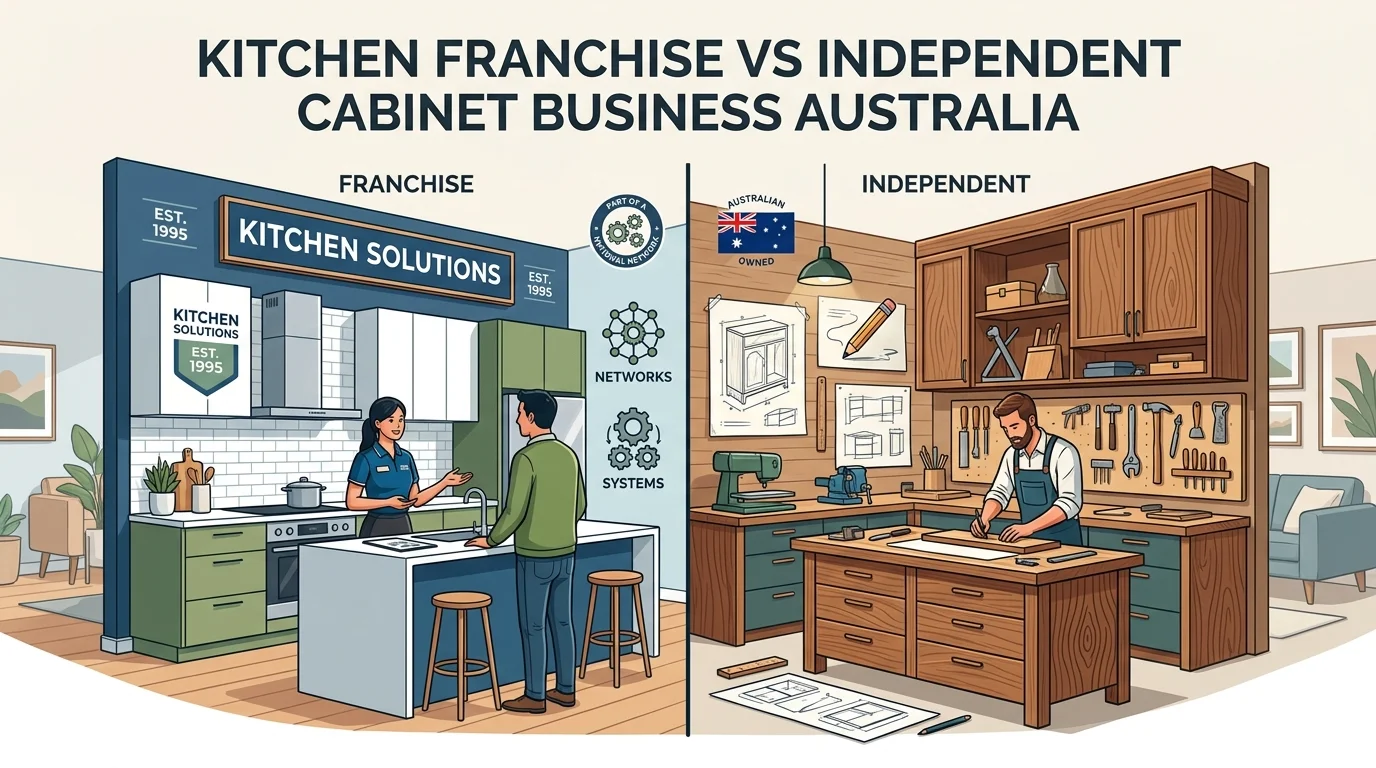
Australia’s cabinetry market offers a real opportunity for entrepreneurs, but it is also shaped by clear business realities. The broader Australian furniture and fitted-furniture sector has been valued in the multi-billion-dollar range, while the kitchen manufacturing and cabinetry segment continues to benefit from housing turnover, renovation demand, and the ongoing trend toward custom storage solutions. At the same time, industry data shows a competitive environment: ABS building approvals have stayed volatile in recent years, and renovation spending remains a major driver of cabinet demand rather than new home construction alone. For anyone evaluating a cabinet business in Australia, the key question is not whether demand exists, but which operating model can capture it more efficiently.
Two common paths stand out: launching an independent business or joining a cabinet franchise under a franchise model or dealer model. Each has strengths. Each also carries trade-offs in capital, branding, sourcing, and growth speed. This comparison breaks down both options for entrepreneurs evaluating a kitchen cabinet franchise or planning to build an independent cabinet business in the Australian market.
- What the Australian Cabinetry Market Looks Like
- Independent Cabinet Business: Flexibility and Full Control
- Kitchen Cabinet Franchise: A Faster Route to Market
- Dealer Model vs. Franchise Model: What Is the Difference?
- Which Model Is Better for the Australian Market?
- Why Custom Cabinetry Is Central to Growth
- Operational Factors Entrepreneurs Should Evaluate
- How OPPEIN Fits the Market
- Conclusion: Which Is Better?
- FAQs
What the Australian Cabinetry Market Looks Like
Before choosing a business model, it helps to understand the market forces shaping demand. Australia’s housing market has created recurring demand for kitchens, wardrobes, laundries, vanities, and full-home storage systems. Consumers increasingly expect design-led, made-to-measure solutions rather than basic off-the-shelf products. In practical terms, that means custom cabinetry and whole-house fitout categories have become more attractive than one-off product sales alone.
Several factors support this trend:
- Renovation demand: Many homeowners are upgrading kitchens and storage spaces instead of moving.
- Apartment and townhouse growth: Smaller dwellings increase demand for space-saving cabinetry.
- Speed and certainty: Customers expect accurate quoting, fast design turnaround, and reliable installation coordination.
For entrepreneurs, this means the best cabinet business model is one that can manage design, sourcing, and execution efficiently while maintaining strong margins.
Independent Cabinet Business: Flexibility and Full Control
An independent business gives owners complete freedom over brand, products, pricing, and customer experience. For experienced operators, this can be an attractive route, especially if they already understand local trade networks or have construction and project management knowledge.
Advantages of an Independent Business
- Full control over brand positioning: You choose the market segment, style, and service promise.
- Flexible supplier selection: You can source from multiple factories or local manufacturers.
- Custom operating model: You can build a business around your own workflow, sales process, and margin structure.
Challenges of an Independent Business
- Higher setup risk: You must build the business from scratch, including processes, systems, and supplier relationships.
- Slower market trust: New brands often require more time and marketing investment to win customer confidence.
- Design and quoting burden: Without central support, every showroom must manage its own technical standards and quotation accuracy.
- Training responsibility: Hiring, onboarding, and product education fall entirely on the owner.
For a founder with strong industry experience, an independent business can be rewarding. But for many first-time entrepreneurs, the challenge is not just selling cabinets. It is building a repeatable operating system that can reliably deliver custom cabinetry across multiple projects and product lines.
Kitchen Cabinet Franchise: A Faster Route to Market
A kitchen cabinet franchise offers a more structured pathway into the market. Instead of building everything from the ground up, the franchisee operates under a proven brand and business framework. This is especially useful for entrepreneurs who want to reduce launch uncertainty and gain access to sourcing, design, and sales support from day one.
Advantages of a Franchise Model
- Brand credibility: An established name can help shorten the sales cycle.
- Operational support: Training, showroom guidance, and business systems reduce startup friction.
- Factory-direct sourcing: Centralised supply can improve cost control and product consistency.
- Faster quoting: Design and quotation tools help reduce turnaround time and support more leads.
- Scalable playbook: A tested business model can make expansion easier.
Limitations of a Franchise Model
- Less independence: Franchisees usually follow brand guidelines and approved product ranges.
- Initial investment: Entry costs may be higher than starting small independently.
- Ongoing fees or obligations: Depending on the structure, there may be royalties, marketing contributions, or operational requirements.
- Process discipline: Success depends on following the system correctly, not reinventing it.
For many investors, the biggest advantage of a cabinet franchise is speed to revenue. A structured model can reduce the risk of inconsistent quoting, poor supplier coordination, and weak customer conversion.
Dealer Model vs. Franchise Model: What Is the Difference?
In the cabinetry sector, some businesses operate as dealers rather than franchisees. While the terms are sometimes used loosely, they are not the same.
| Model | How It Works | Typical Benefit | Typical Trade-Off |
|---|---|---|---|
| Independent business | Owner builds brand, sourcing, and systems from scratch | Maximum control | Highest startup burden |
| Franchise model | Owner operates under a licensed brand and support system | Proven structure and training | Less autonomy |
| Dealer model | Owner distributes or sells products under a supplier relationship | Lower brand-build burden | Dependence on supplier terms and product strategy |
A dealer model can work well for entrepreneurs who want to focus on sales and project delivery without developing every business component internally. A franchise model may be stronger where brand consistency, showroom presentation, and customer journey are central to the growth plan. The right choice depends on whether the entrepreneur values control, support, or speed to market more highly.
Which Model Is Better for the Australian Market?
There is no single answer for every operator. The better model depends on experience, capital, and long-term goals.
Choose an Independent Business if you:
- Already have cabinetry industry experience
- Have reliable supplier relationships
- Want full control over pricing and operations
- Are comfortable investing time into brand building
- Can manage technical and service complexity in-house
Choose a Franchise or Dealer Model if you:
- Want to launch faster with a clearer system
- Prefer proven sourcing and product support
- Need training and sales infrastructure
- Want to reduce quoting and design friction
- Plan to scale into multiple categories, such as kitchens, wardrobes, bathrooms, doors, and custom furniture
For many overseas dealers entering Australia, the franchise or dealer model is often the more practical entry point. The market is competitive, and customers expect fast response times, accurate designs, and dependable delivery. A business model that supports those expectations from the beginning can improve the odds of success.
Why Custom Cabinetry Is Central to Growth
The strongest opportunities in the Australian cabinet business are increasingly tied to custom cabinetry rather than simple retail resale. Customers want solutions tailored to room dimensions, lifestyle needs, and visual preferences. That creates room for businesses that can bundle design, measurement, manufacturing, and installation support into one customer journey.
Custom cabinetry also improves average transaction value. Instead of selling a single product category, operators can expand across:
- Kitchen cabinets
- Wardrobes
- Bathroom vanities
- Laundry storage
- Doors and windows
- Whole-house custom furniture
This broader offer is where integrated suppliers and established brands often have an advantage. They can help dealers and franchisees cross-sell multiple products into the same project, increasing customer lifetime value and margin potential.
Operational Factors Entrepreneurs Should Evaluate
When comparing a cabinet business against a cabinet franchise, decision-makers should assess more than brand recognition.
- Supply chain reliability: Can products arrive consistently and on time?
- Quotation efficiency: How quickly can you convert enquiries into proposals?
- Showroom support: Is there help with display planning and customer presentation?
- Training quality: Will your team be trained in sales, design, and product knowledge?
- Product range: Can the supplier support growth across multiple home categories?
- Scalability: Can the model support a second location or broader territory later?
These are the practical issues that determine whether the business model works in day-to-day operations, not just on paper.
How OPPEIN Fits the Market
For entrepreneurs evaluating a globally established whole-house customization brand, OPPEIN offers a structure designed to support both B2C retail and B2B wholesale franchise opportunities in Australia. The appeal lies in combining factory-direct sourcing with showroom assistance, professional training, and rapid 3D design and quotation tools. Just as importantly, the portfolio extends beyond kitchens into wardrobes, bathrooms, doors, windows, and custom furniture, which supports a broader revenue strategy than a single-product cabinet business.
For dealers and franchise candidates, this type of business model can reduce startup friction while still allowing room for local market development. It is particularly relevant for overseas operators who want a more systemised entry into Australia rather than building an independent operation from zero.
Conclusion: Which Is Better?
If your priority is complete autonomy and you already have strong industry capability, an independent business can be a viable path. If your priority is faster market entry, stronger support, and a more predictable operating structure, a cabinet franchise or dealer model may be the better choice.
In the Australian market, where customers expect speed, design quality, and reliable supply, many entrepreneurs will find that a structured franchise model offers a better balance of risk and growth potential. The best answer depends on how much control you want, how much support you need, and how quickly you want to scale.
Ready to build a kitchen cabinet business with a globally established whole-house customization brand? OPPEIN offers both B2C retail and B2B wholesale franchise opportunities in Australia, supported by factory-direct sourcing, showroom assistance, professional training, rapid 3D design and quotation tools, and a broad portfolio spanning kitchens, wardrobes, bathrooms, doors, windows, and custom furniture.
Explore the OPPEIN Australia Franchise Program to review franchise requirements, investment options, and support available for your market.
FAQs
It depends on your experience and goals. A franchise is usually better for faster setup, support, and brand trust. An independent business is better for operators who want full control and already have industry experience.
The main advantage is having a proven business model with brand support, supplier systems, training, and sales tools that reduce startup risk and improve operational consistency.
No. A dealer model usually focuses on product distribution or resale through a supplier relationship, while a franchise model involves operating under a licensed brand with a defined support system.
Custom cabinetry matches the demand for tailored storage, better use of space, and coordinated whole-home design. It also supports higher project values and better cross-selling opportunities.
Look for reliable supply, strong training, showroom support, fast design and quoting tools, and a product range that can grow beyond kitchens into wardrobes, bathrooms, and whole-house fitouts.