
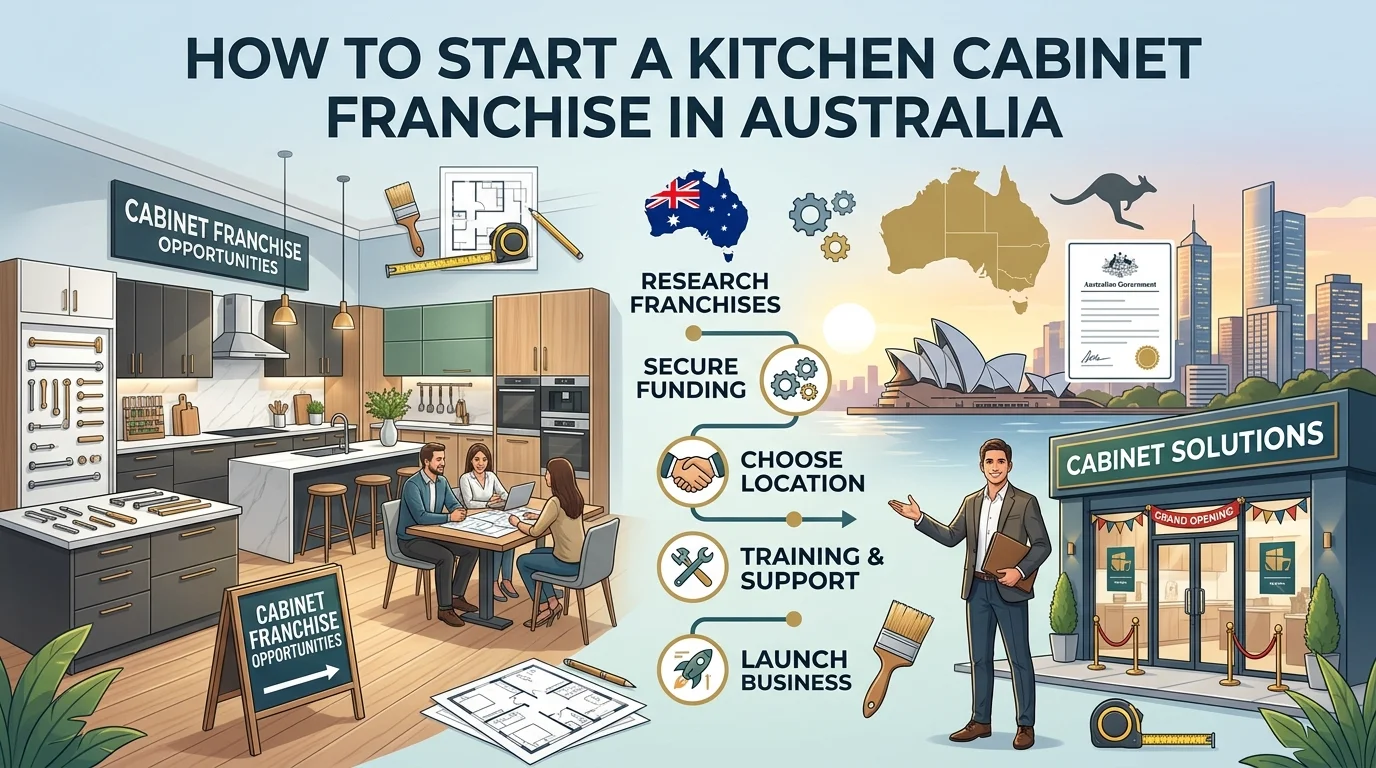
Australia’s renovation market offers a substantial opportunity for specialist cabinetry businesses. The Australian Bureau of Statistics has reported annual alterations and additions to residential buildings at approximately A$13 billion in recent years, while the 2021 Census recorded more than 10 million private dwellings nationwide. These figures indicate a large installed housing base and continuing demand for kitchen upgrades, storage improvements and whole-home customization.
For an entrepreneur, a kitchen cabinet franchise Australia model can provide a more structured route into this market than building an independent brand from the ground up. A franchise may combine an established product portfolio, factory-direct sourcing, design systems, training and operational support. However, success still depends on local market research, disciplined financial planning and reliable project execution.
This step-by-step guide explains how to assess, establish and operate a kitchen renovation franchise or cabinet franchise in Australia.
- 1. Assess the Australian Kitchen Cabinet Opportunity
- 2. Choose the Right Franchise Business Model
- 3. Review the Franchisor and Supply Chain
- 4. Prepare a Detailed Financial Plan
- 5. Understand Australian Legal and Compliance Requirements
- 6. Select a Strategic Showroom Location
- 7. Build a Capable Local Team
- 8. Create a Local Marketing and Sales System
- 9. Launch, Measure and Improve
- Conclusion
- FAQs about Cabinet Franchise in Australia
1. Assess the Australian Kitchen Cabinet Opportunity
Begin by defining the demand in your chosen territory. Kitchen customers commonly include homeowners renovating older properties, investors preparing homes for sale or rent, apartment owners seeking space-efficient storage, and new-home buyers requiring coordinated cabinetry.
Examine local indicators such as:
- Housing age, density and ownership levels
- New residential construction and renovation activity
- Household income and property values
- Competitor showroom locations and price positioning
- Demand for kitchens, wardrobes, bathrooms and other joinery
Do not evaluate the opportunity only by counting kitchen retailers. A territory with several competitors may still support a new business if competitors have long lead times, limited design capability, narrow product ranges or weak after-sales service. Interview builders, interior designers, property developers and homeowners to identify recurring gaps.
2. Choose the Right Franchise Business Model
Kitchen cabinetry franchises can operate through different models. A B2C retail franchise typically focuses on a showroom, consultations, design appointments and direct sales to homeowners. A B2B wholesale model may serve builders, developers, designers, contractors and independent dealers. Some brands support both approaches.
When comparing a franchise business, clarify:
- Whether the territory is exclusive or protected
- Whether a physical showroom is required
- Which products and services are included
- Whether customers can purchase online or through trade channels
- How franchise fees, royalties and marketing contributions are calculated
- Whether you may add complementary products or local suppliers
A broader whole-house customization model can diversify revenue beyond kitchens. Wardrobes, bathrooms, doors, windows and custom furniture may increase the average project value and create cross-selling opportunities. Confirm, however, that your team and installation network can deliver each category to the required standard.
3. Review the Franchisor and Supply Chain
The franchisor’s manufacturing and supply-chain capabilities directly affect your reputation. Request detailed information about factory capacity, quality control, materials, hardware, packaging, export experience and delivery processes.
Important questions include:
- Where are cabinets manufactured, and what certifications apply?
- What are the standard production and shipping lead times?
- How are damaged or missing components handled?
- Can products be customized for Australian homes and regulations?
- Are replacement parts and hardware available after installation?
- How are design revisions, approvals and production changes documented?
Factory-direct sourcing can improve product consistency and pricing, but international supply requires careful planning. Assess customs processes, port delays, container availability, Australian warehousing and buffer-stock policies. A low purchase price is not valuable if delays create installation cancellations or expensive remedial work.
4. Prepare a Detailed Financial Plan
Before signing an agreement, prepare a territory-specific feasibility study. Your plan should separate one-time establishment costs from recurring operating expenses.
Potential startup costs include:
- Initial franchise or licensing fees
- Showroom lease, fit-out and signage
- Kitchen, wardrobe and bathroom displays
- Computers, design software and quotation tools
- Vehicle, warehousing and sample storage
- Professional fees, insurance and registrations
- Launch marketing and local advertising
- Working capital for wages, deposits and freight
Build conservative projections using several sales scenarios. Estimate leads, consultations, conversion rate, average order value, gross margin, installation cost and cancellation risk. Include a cash-flow schedule because cabinetry businesses may pay deposits to suppliers well before final customer payments are collected.
Ask the franchisor for sample unit economics, but validate every assumption independently. Speak with an accountant familiar with Australian franchising and retail operations. Review the franchise disclosure documents and obtain independent legal advice before committing.
5. Understand Australian Legal and Compliance Requirements
Franchise operations in Australia are governed by the Franchising Code of Conduct. The agreement, disclosure documents, cooling-off provisions, dispute processes and marketing fund arrangements should be reviewed carefully with a qualified franchise lawyer.
Your business may also need an Australian Business Number, appropriate company or business registration, GST registration and state or territory-specific licences. If you provide installation or building-related services, investigate the licensing requirements in the jurisdictions where you operate. Requirements can differ between states and territories.
Product and project compliance also matters. Confirm that cabinetry, electrical components, plumbing interfaces, glass, doors and other supplied elements are suitable for Australian standards and building requirements. Use written contracts that define design approvals, measurement responsibility, payment milestones, variations, delivery, installation, warranties and complaint handling.
6. Select a Strategic Showroom Location
A showroom remains valuable because customers often want to touch door finishes, compare hardware and visualize layouts before ordering. Choose a location that is easy to access and relevant to your target market rather than simply selecting the lowest rent.
Consider proximity to home-improvement precincts, display-home areas, builders, designers and affluent residential suburbs. The showroom should demonstrate your core capabilities without tying up excessive capital in too many displays. Use a mixture of complete kitchens, compact storage solutions, wardrobe interiors, hardware samples and material boards.
Digital consultation can complement the showroom. High-quality photography, 3D layouts and remote meetings allow you to reach customers beyond the immediate retail area and support trade clients who do not visit in person.
7. Build a Capable Local Team
A successful cabinet franchise depends on more than product quality. Customers judge the business by communication, measurement accuracy, installation and problem resolution.
Key roles may include a franchise owner or manager, kitchen designers, a sales consultant, an estimator or project coordinator, and qualified installation partners. At launch, some roles can be combined, but responsibilities must be clear.
Prioritize training in design software, product specifications, Australian measurement practices, sales consultations, contract administration and quality inspection. Establish a documented handover from initial design to site measure, production approval, delivery and installation. A final inspection checklist can reduce defects and improve referrals.
8. Create a Local Marketing and Sales System
Use the franchisor’s brand assets while developing local demand. Your marketing should target customers at different stages of the renovation journey.
- Optimize your Google Business Profile and local search pages
- Publish completed projects with professional photography
- Build referral relationships with builders, designers and real estate professionals
- Run showroom consultation events and renovation seminars
- Use paid search for terms such as kitchen renovation and custom cabinetry
- Request verified reviews after successful installations
Design a consistent sales process: qualify the enquiry, confirm the scope, conduct a measured consultation, prepare the 3D design and quotation, document revisions, secure approval and schedule production. Fast, accurate quotations can be a meaningful competitive advantage, especially when supported by professional 3D design tools.
9. Launch, Measure and Improve
Set performance targets for enquiries, consultation bookings, quote turnaround, conversion rate, average order value, gross margin, installation defects and customer satisfaction. Review these metrics monthly rather than relying only on total sales.
Early customer feedback may reveal that your territory needs different display styles, price points or product combinations. Use that information to refine the showroom and advertising. Maintain enough working capital to manage seasonal demand, freight fluctuations and warranty work during the first year.
The strongest franchise operators balance the franchisor’s proven systems with local commercial judgment. They follow approved processes while adapting language, partnerships, product emphasis and promotional activity to their Australian market.
Conclusion
Starting a kitchen cabinet franchise in Australia requires more than securing a brand name. Entrepreneurs must validate local demand, understand the franchise agreement, test financial assumptions, verify supply reliability and build a dependable design-to-installation process.
A well-supported cabinet franchise can reduce the risks associated with independent market entry by providing product development, operating systems, training and brand resources. The right partner should also offer sufficient flexibility for local sales development and long-term growth.
Ready to build a kitchen cabinet business with a globally established whole-house customization brand? OPPEIN offers both B2C retail and B2B wholesale franchise opportunities in Australia, supported by factory-direct sourcing, showroom assistance, professional training, rapid 3D design and quotation tools, and a broad portfolio spanning kitchens, wardrobes, bathrooms, doors, windows, and custom furniture.
Explore the OPPEIN Australia Franchise Program to review franchise requirements, investment options, and support available for your market.
FAQs about Cabinet Franchise in Australia
Profitability depends on territory, pricing, lead generation, gross margin, installation control and overhead management. Prepare an independent financial forecast rather than relying on industry averages or optimistic sales assumptions.
Costs vary according to the franchisor, showroom format, location, display quantity, staffing and working capital requirements. Request a complete investment schedule covering fees, fit-out, inventory, marketing, freight and operating reserves.
Industry experience is useful but not always essential. Strong business management, consultative selling and project coordination skills are important. A credible franchisor should provide product, design and operational training.
Some franchise systems support both retail and wholesale channels, while others restrict territory or customer types. Confirm channel rights, pricing policies and lead ownership before signing the agreement.
Assess product quality, factory capacity, Australian compliance, delivery performance, warranty support, franchisee training, marketing assistance, software systems, territory protection and the financial health of the franchisor.