
Quick Overview
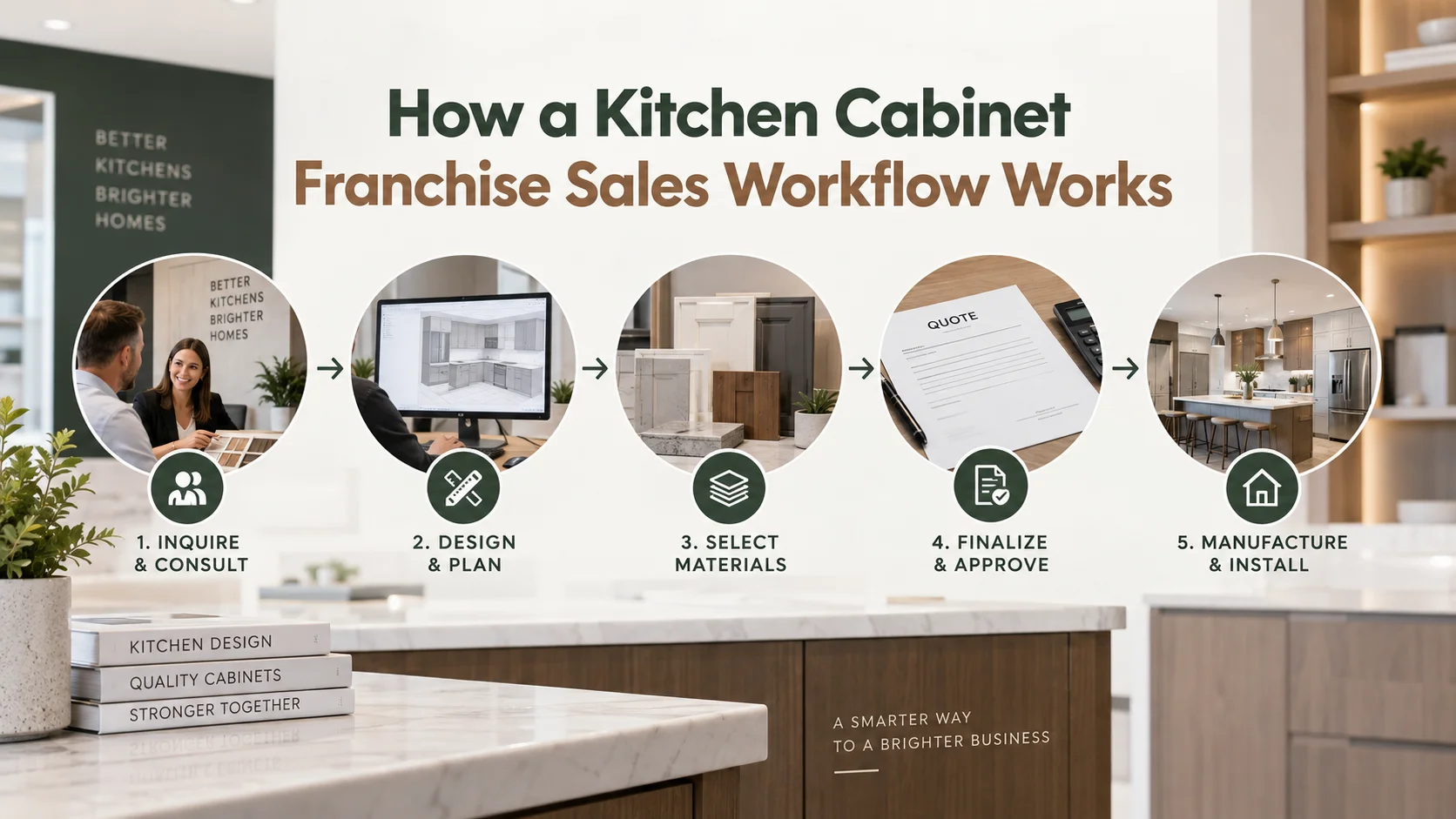
A successful kitchen cabinet franchise sales workflow relies on a structured process from lead qualification and accurate measurements to design, revisions, quoting, and order confirmation. Standardized procedures, digital 3D tools, and factory-direct sourcing help dealers reduce errors, improve efficiency, and present value beyond price. Franchise support further strengthens training, consistency, and customer confidence.
Key Takeaways
- - A structured workflow improves consistency, conversion rates, and margin protection in cabinet sales.
- - Accurate measurements and technical checks are essential to avoid errors, redesigns, and installation issues.
- - Customer needs should be translated into a clear design brief before creating the first 3D layout.
- - Revisions must be tracked professionally with version control to keep designs and quotations aligned.
- - Transparent quotations and value-based presentations help dealers win business beyond competing on price.
For an overseas dealer, a successful cabinet business depends on more than attractive kitchen cabinets or a competitive supplier price. Customers expect accurate design, transparent quotations, dependable lead times, and professional support throughout the buying process. A structured sales workflow helps franchisees deliver that experience consistently while protecting margins and improving conversion rates.
This guide explains how kitchen cabinet franchise operations typically move from the first customer consultation to the final quotation. It also shows how digital design tools, factory-direct sourcing, and standardized procedures can help dealers build a more efficient custom cabinetry business.
- Why a Structured Cabinet Sales Workflow Matters
- Step 1: Qualify the Lead and Understand the Project
- Step 2: Collect Accurate Measurements and Technical Information
- Step 3: Translate Customer Needs into a Design Brief
- Step 4: Create the Initial 3D Design
- Step 5: Manage Revisions Professionally
- Step 6: Build an Accurate Quotation
- Step 7: Present Value, Not Just Price
- Step 8: Confirm the Order and Handover
- How Franchise Support Improves Sales Efficiency
- Conclusion: Turn a Repeatable Process into a Stronger Business
- FAQs
Why a Structured Cabinet Sales Workflow Matters
Whole-house customization involves multiple decisions, including room dimensions, storage requirements, finishes, accessories, appliances, hardware, installation, and budget. Without a defined workflow, sales teams may overlook critical measurements, quote inconsistently, or spend too much time revising designs.
A standardized process gives every project a clear path:
- Lead qualification and needs discovery
- Site measurement and technical review
- Concept design and product selection
- 3D presentation and customer revisions
- Cost calculation and quotation
- Order confirmation, production, and installation coordination
For franchise owners, this consistency is especially valuable. It makes employee training easier, improves customer confidence, and allows the business to manage more projects without relying entirely on one experienced salesperson.
Step 1: Qualify the Lead and Understand the Project
The sales workflow begins before any cabinet layout is drawn. The salesperson should first understand the customer, the property, and the commercial opportunity. This initial conversation prevents the team from preparing a detailed design for a project that is not ready, suitable, or financially viable.
Key questions for the first consultation
- Is the customer building, renovating, or replacing an existing kitchen?
- Which rooms require products: kitchen, wardrobe, bathroom, laundry, or living area?
- What is the expected project timeline?
- Has the customer established a budget range?
- Are appliances already selected?
- Does the property have unusual access, structural, or installation conditions?
At this stage, the objective is not to force a purchase. It is to establish scope and identify the right next action, such as an in-store consultation, a site visit, or a preliminary budget discussion. A professional approach builds trust and helps the dealer prioritize qualified opportunities.
Step 2: Collect Accurate Measurements and Technical Information
Accurate information is the foundation of custom cabinetry. A visually appealing design cannot compensate for incorrect dimensions. The dealer should collect wall lengths, ceiling height, window and door positions, plumbing points, electrical outlets, gas connections, ventilation requirements, and appliance dimensions.
Measurements should be recorded systematically rather than relying on handwritten notes alone. Photographs, floor plans, and site observations should be stored with the customer record. It is also important to confirm whether walls are square, floors are level, and existing services can be relocated.
For a franchise operation, a standardized measurement checklist reduces errors across different salespeople and locations. The checklist should distinguish between information that is confirmed and information that still requires verification. Before production begins, the dealer should complete a final technical review and obtain customer approval of the relevant specifications.
Step 3: Translate Customer Needs into a Design Brief
Once the site information is available, the salesperson or designer converts the customer’s preferences into a practical design brief. This brief connects lifestyle requirements with product decisions.
For example, a family kitchen may require more drawer storage, durable surfaces, and a dedicated pantry. An investment property may prioritize cost control, easy maintenance, and a short delivery schedule. A premium renovation may emphasize material finishes, integrated appliances, specialized hardware, and coordinated design across several rooms.
The brief should define:
- Preferred layout, such as one-wall, galley, L-shaped, U-shaped, or island kitchen
- Storage priorities and organization needs
- Door styles, colors, finishes, and benchtop preferences
- Appliance locations and integration requirements
- Hardware, lighting, accessories, and internal fittings
- Desired products for other rooms in the home
- Budget expectations and project priorities
This stage is where a cabinet business can differentiate itself. Customers are not simply buying cabinets; they are buying a solution to improve how their home functions.
Step 4: Create the Initial 3D Design
Design software helps the customer understand the proposed result before making a financial commitment. A 3D model can show cabinet proportions, colors, appliance placement, storage configuration, and the relationship between the kitchen and surrounding spaces.
An efficient design presentation should balance visual impact with technical accuracy. The salesperson should explain why specific cabinet modules, clearances, work zones, and accessories were selected. The presentation should also identify assumptions, such as appliance sizes or unfinished wall conditions, so the customer understands what may affect the final scope.
Rapid 3D design and quotation tools are particularly useful in franchise environments. They allow teams to produce consistent proposals, shorten response times, and revise layouts during the consultation. Faster design does not mean reducing quality; it means using a repeatable process to focus more attention on customer decisions and project details.
Step 5: Manage Revisions Professionally
Most custom cabinetry projects require revisions. Customers may change the island size, compare door finishes, add storage accessories, or adjust the budget after seeing the first design. Revisions should be managed as controlled project stages rather than informal conversations that create confusion.
Each revision should have a version number or date. The dealer should record what changed, how the change affects the price, and whether it affects production or installation. A clear revision process helps prevent disputes and ensures that the quotation matches the latest approved design.
Sales teams should also guide customers toward decisions. Presenting too many combinations can slow the sale. A better approach is to recommend a suitable configuration, explain two or three alternatives, and show the practical and financial effect of each option.
Step 6: Build an Accurate Quotation
The quotation is the commercial result of the design process. It should be detailed enough for the customer to understand what is included, while remaining easy to review. A professional quotation normally includes cabinet units, panels, benchtops, hardware, accessories, appliances if applicable, delivery, installation, taxes, and any exclusions.
For kitchen cabinets and other custom products, pricing should be connected to the approved design rather than estimated from a vague room size. The dealer should verify quantities, dimensions, materials, finishes, and special components before issuing the proposal.
Essential quotation elements
- Customer and project information
- Design version and quotation date
- Product descriptions, quantities, and specifications
- Finish and hardware selections
- Delivery and installation terms
- Estimated production and delivery schedule
- Payment milestones and quotation validity
- Items excluded from the price
- Conditions for changes, cancellations, and site variations
Transparent pricing supports trust and protects the dealer from unexpected costs. If site conditions, installation, or services are not included, they should be stated clearly. A factory-direct supplier can also help the franchisee maintain more predictable product pricing and access a wider range of finishes and components.
Step 7: Present Value, Not Just Price
When presenting the quotation, salespeople should explain the value behind the design. A lower initial price may involve fewer storage solutions, simpler hardware, or less durable materials. A higher price may reflect stronger construction, upgraded finishes, better internal organization, or more complex installation.
The presentation should connect product choices to customer priorities. For example, soft-close drawers may improve daily convenience, while tall storage can increase capacity in a compact kitchen. A coordinated wardrobe, bathroom vanity, and kitchen package may also create a more consistent whole-house result.
Overseas dealers should avoid competing only on price. A reliable design process, accurate documentation, warranty support, and dependable communication are meaningful commercial advantages.
Step 8: Confirm the Order and Handover
After the customer approves the quotation, the dealer should complete a formal order confirmation. The final documentation should include approved drawings, specifications, finishes, measurements, payment status, and agreed delivery conditions.
A structured handover from sales to production and installation is essential. Every team member should know which information has been confirmed and which items require follow-up. Before manufacturing, the dealer should conduct a final check against the site conditions and customer approval.
Good kitchen cabinet franchise operations continue after the sale. Dealers should track production, shipping, delivery, installation, defect resolution, and customer satisfaction. This data can reveal recurring issues and improve future workflows.
How Franchise Support Improves Sales Efficiency
A franchise model can provide more than a brand name. For an overseas dealer, practical support may include showroom planning, product training, design systems, quotation tools, marketing materials, sourcing assistance, and guidance on local market requirements.
These resources help reduce the learning curve for a new cabinet business. They also create a more consistent customer experience across locations. A broad product portfolio covering kitchens, wardrobes, bathrooms, doors, windows, and custom furniture can increase the average project value and support cross-selling through whole-house solutions.
Conclusion: Turn a Repeatable Process into a Stronger Business
A cabinet franchise sales workflow works best when every stage is connected: qualified leads lead to accurate measurements, accurate measurements support practical designs, approved designs produce reliable quotations, and complete orders move smoothly into production and installation.
For entrepreneurs evaluating suppliers, the right partner should support both product quality and operational discipline. Factory-direct sourcing, professional training, rapid 3D design and quotation tools, and showroom assistance can help dealers serve customers with greater confidence and efficiency.
Ready to build a cabinet business with a globally established whole-house customization brand? OPPEIN offers both B2C retail and B2B wholesale franchise opportunities in Australia, supported by factory-direct sourcing, showroom assistance, professional training, rapid 3D design and quotation tools, and a broad portfolio spanning kitchens, wardrobes, bathrooms, doors, windows, and custom furniture.
Explore the OPPEIN Australia Franchise Program to review franchise requirements, investment options, and support available for your market.
FAQs
It is the repeatable process used to move a customer from initial consultation through measurement, design, revisions, quotation, order confirmation, production, delivery, and installation.
Accurate measurements help ensure that cabinets, appliances, benchtops, and services fit the property. They reduce redesigns, installation problems, delays, and unexpected costs.
3D tools allow customers to visualize layouts, finishes, storage, and appliances before ordering. They can also help sales teams revise designs and prepare quotations more efficiently.
A quotation should identify the design version, cabinet specifications, finishes, hardware, accessories, benchtops, delivery, installation, taxes, payment terms, schedule, exclusions, and change conditions.
Dealers should evaluate product range, manufacturing capability, design and quotation support, training, showroom assistance, logistics, documentation, after-sales service, and the supplier’s ability to support local market requirements.